Architecture
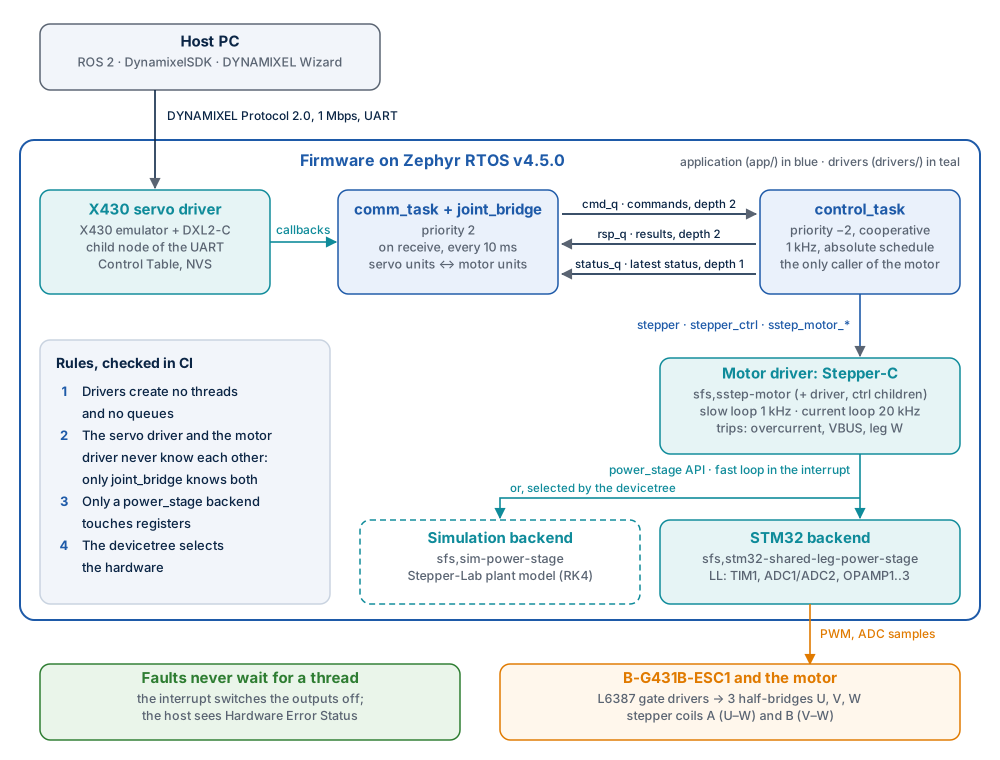
Doppelstep is a Zephyr module with one application. Hardware and libraries sit behind drivers. The application owns the threads and the queues and connects the drivers. This page explains the layers, their rules and the path of a command, so you can read the code or add to it. For a new MCU, continue with Porting to a new MCU family.
Layout
doppelstep/
├── zephyr/module.yml     the repository is a Zephyr module
├── CMakeLists.txt, Kconfig   build modules/ and drivers/
├── app/                  application: tasks, queues, register mapping
├── drivers/              power_stage/, motor/, x430/
├── include/doppelstep/drivers/   public driver APIs
├── dts/bindings/         devicetree bindings and the sfs vendor prefix
├── boards/               out-of-tree board
├── modules/              build glue of the libraries
└── tests/                ztest suites and pytest SIL and integration tests
The layout follows the Zephyr example-application. West finds the module because the manifest
repository is a west project, so the application and every test application get the drivers,
the board and the bindings without extra CMake.
Four rules
- Drivers create no threads and no queues. A driver offers a function such as
sstep_motor_process()orx430_servo_process(), and the application calls it from a loop it owns. The only exception is the fast loop, which stays in the interrupt inside the driver. - The X430 driver does not know the motor, and the motor driver does not know DYNAMIXEL.
Only
app/src/joint_bridge.cknows both, so X430 units never reach the motor driver. - Only a
power_stagebackend touches registers. LL calls, the cycle counter, OPAMPs and direct interrupts appear nowhere else. - The devicetree selects the hardware. The
power-stagephandle of the motor selects the backend, the servo is a child node of its UART, and a phandle selects the flash partition.
scripts/check-layers.sh enforces rules 2 and 3 in CI, and also rejects floating point above
the backends and any output switching in the simulation backend.
Drivers
| Driver | Compatible | API |
|---|---|---|
| Power stage, STM32 | sfs,stm32-shared-leg-power-stage |
Class power_stage (power_stage.h) |
| Power stage, simulation | sfs,sim-power-stage |
Class power_stage, plus power_stage_sim.h |
| Motor (Stepper-C) | sfs,sstep-motor with the children sfs,sstep-stepper-driver and sfs,sstep-stepper-ctrl |
Zephyr classes stepper and stepper_ctrl, plus sstep_motor.h |
| Servo (X430 emulator) | sfs,x430-servo, a child of the UART |
x430_servo.h |
Why a custom class for the power stage? Zephyr's PWM API has no dead time, center alignment
or complementary outputs, and its ADC API has no timer-triggered injected conversions. A 20 kHz
current loop needs all of them, so MCU-specific code is unavoidable. The power_stage class
keeps that code in one file per MCU family, the way Zephyr does for its own driver classes.
Why three nodes for the motor? Zephyr splits stepper devices into a hardware driver
(stepper: enable, disable, microsteps) and a motion controller (stepper_ctrl: moves, ramp,
position). Integrated chips such as adi,tmc50xx use a parent node with one child for each
class, and Stepper-C plays the same role. What the classes lack (slow loop, status, currents,
faults) is the extension on the parent node.
Contexts
| Context | Priority | Rate | Work | Never |
|---|---|---|---|---|
| Interrupt of the backend | Highest (on the STM32: zero-latency ADC1_2 interrupt) | PWM rate, 20 kHz | Currents and VBUS, shared-leg trip, fast loop sstep_fast_loop(), immediate shutdown on a fault |
Kernel calls |
control_task |
−2, cooperative | 1 kHz, absolute schedule | Slow loop sstep_motor_process(), commands, publication of the status |
Waiting on an outgoing queue |
comm_task |
2 | On receive, and every 10 ms | x430_servo_process(), joint_bridge, live registers |
Calling the motor driver |
main |
0 | — | Startup, then the STATUS LED | Sending commands |
Every call into the motor driver comes from control_task, so the driver needs no lock for its
status. With CONFIG_ASSERT the driver checks this.
Queues
app/src/app_msg.h defines three queues. Messages travel by value.
| Queue | Direction | Depth | Use |
|---|---|---|---|
cmd_q |
comm → control | 2 | Commands, with a sequence number |
rsp_q |
control → comm | 2 | Results, 0 or -errno |
status_q |
control → readers | 1 | Latest status only |
control_task never waits on an outgoing queue, so communication cannot stall the control loop.
app_call() waits at most CONFIG_SFS_CMD_TIMEOUT_MS and discards a late answer by its sequence
number, so comm_task cannot hang either. A command that timed out may still execute later, and
the log records the timeout.
A command, from the bus to the motor
Goal Position:
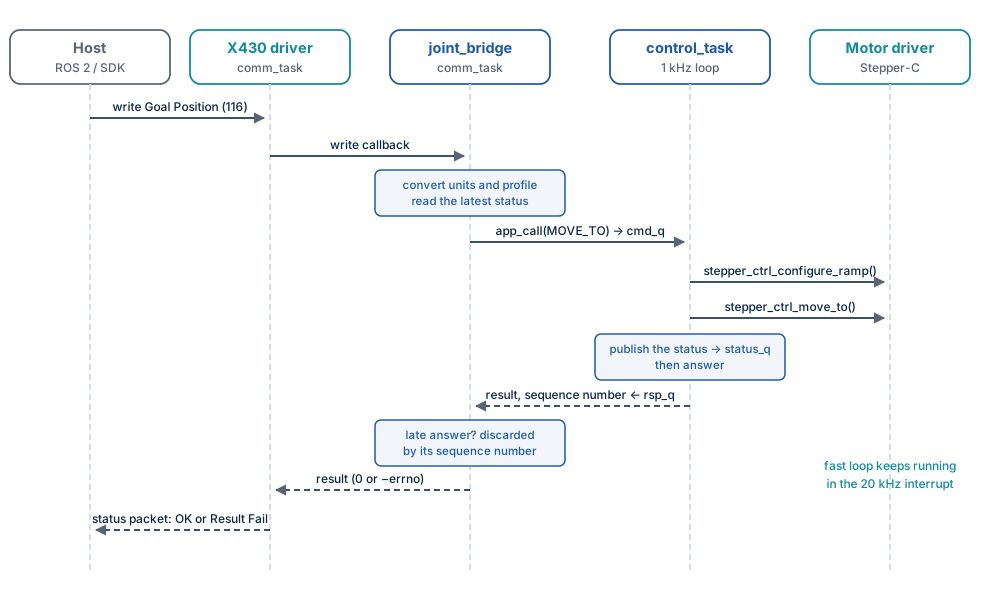
The host gets the result in the status packet, so joint_bridge waits for it. Because the status
is published before the answer, the sender always sees a status that reflects its command.
| Situation | Reaction | Host sees |
|---|---|---|
| The driver rejects a command | Result in rsp_q |
Result Fail |
| Unsupported Operating Mode | joint_bridge, motor not involved |
Data Range Error |
| Overcurrent, bus voltage, stall | Outputs off in the interrupt, flag in the status | Hardware Error Status, Torque Enable 0 |
cmd_q full, or no answer in time |
-EBUSY or -ETIMEDOUT, log entry on a timeout |
Result Fail |
Motor protection depends on no task, because the interrupt handles electrical faults.
Startup
On the board MCUboot runs first: it checks the signature of the application and waits 500 ms for a firmware update over USART2 (Firmware update). Then the application starts:
- Device initialisation at
POST_KERNEL: power stage, motor driver, servo. Outputs stay off. mainchecks the devices and measures the current sensor offsets.mainstartscontrol_task, which publishes the first status, and connects the servo throughjoint_bridge.mainstartscomm_taskand continues with the LED.
The fast-loop interrupt already runs after step 1, while the motor driver is ready and the sensor
offsets are not yet known. That is safe because the outputs are off, the current trips of Stepper-C
only act when the outputs are on, and aux_trip stays false until calibration has succeeded.
Until step 3 finishes, nothing can send an enable command, so the motor cannot start with uncalibrated sensors. On an error in steps 1 or 2 the tasks do not start. In every error case the outputs stay off and the LED blinks fast.
Configuration
| What | Where |
|---|---|
| Motor, limits, tuning, joint, power stage, PWM, scaling | Devicetree properties (app/boards/*.overlay) |
| Compiled features, threads, buffers, timeouts | Kconfig |
| Board-specific Zephyr options | app/boards/<board>.conf |
| Simulated motor on the board | -DEXTRA_DTC_OVERLAY_FILE=sim.overlay |
| Bootloader, flash layout, serial recovery | app/sysbuild.conf, app/sysbuild/, partitions in the board devicetree |